
Tuesday, January 5, 2010

Is Body Piercing Involves Risks?
 Body piercing may sound like a new-age art but the truth is that we have been practicing it for centuries. Have you ever realised that even your earring hole is a form of body piercing? It is the most common form of body piercing practiced. In India, women routinely pierce their nostrils too. Instances of body piercing have been found in the Bible as well as in Egyptian Mummies.
Body piercing is the piercing of a body part in order to wear jewelery in the opening created. Does that sound crazy? For millions of teenagers and even older people, it is the biggest fashion accessory. People may undergo piercing for a number of reasons. While the most popular reason is aesthetics, sometimes people may pierce for religious, cultural, or sexual reasons. Unusual piercing locations include eyebrows, tongue, lips, nipples, neck, and genital regions. While these may appeal to youngsters, the reception from parents is less than approving. If you are planning to go for it, ensure that you are aware of the risks and possible complications.
Healing
A piercing is nothing but a small wound. Go to a registered body piercer so that the procedure you opt for is aseptic, that is, free from bacterial contamination. Many states in the US have government recognized registered practitioners. Follow the directions for after-care meticulously. Very soon, you will find the punctured tissue growing back and becoming part of the closed system. An eyebrow piercing will take about four to six weeks to heal while a neck piercing can take up to twelve months. Piercing your ear lobes means a healing period of 6 to 8 weeks.
Infections or irritation can occur only if the area opens due to some reason. For example, if you catch a nose ring on a coat hook, there can be problems galore.
Allergies
Quite a few body piercing enthusiasts may be allergic to piercing. A study on body art by Dr. Anne Laumann of North-western University found that women may be more allergic to body piercing. One in four women may display an allergic reaction to metal jewelery. The quality of the metal is of great importance. With a 14-karat gold stud, there is a greater chance of infection due to the amount of nickel in it. The risks may be minimized with pure 24-karat gold. Swollen and itchy, red skin are the primary signs of an allergy. Your doctor will suggest a topical steroid cream for it.
Closure

Unusual Piercings
Oral piercing
If done improperly, there is every chance of your teeth chipping or breaking due to lip and tongue rings. Ask for studs in the lip to be placed in a neutral space along the lower gum line. This will prevent damage around the mouth area. Tongue piercing needs to be angled such that they do not catch in the palate on the roof of your mouth or the sublingual web along the bottom. Acrylic rather than metal jewellery is considered safest for the mouth region. This is because metal can easily chip teeth and cause injuries.
According to the Association of Professional Piercers, when properly performed, an oral piercing procedure will last only for a few seconds and involve no bloodshed or swelling. People with oral piercings are advised not to share plates and other eating utensils. Though the mouth is exposed to a variety of germs, the saliva has several antimicrobial factors that can easily defend you against these pathogens. However, if you go to an unsafe clinic or you default on your aftercare, there can be severe complications. Pain and bleeding, infections, dental and heart problems, injury due to swallowing the jewelery, drooling, and bad breath are some of the risks. The American Dental Association is against oral piercing and deems it a public health hazard. Some gruesome photographs only intensify the debate.
Navel Piercing

Monday, January 4, 2010

Nose Piercings - History, Types, Care
 Nose piercing is an old type of body modification. It is mentioned in the Bible and was first recorded in the Middle East 4000 years ago. But there is information that nose piercing started even around 6000 years ago. Nose piercing was widespread among the ancient nomadic Berber tribes of Africa, the Bedouins of the Middle East. The larger the ring was, the wealthier was his wearer. The nose ring was also given as the gift at the wedding- the husband gave it to his wife as the sign of protection to her if she would be divorced.
In India, nose piercings were brought in the 16th century by the Moghul emperors from the Middle East. Left nostrils were a common place for a piercing, but piercing in both nostrils was also met. A chain joining the ring with an ear was rather widespread. Left nostrils were prevalent in nose piercing because in India it was associated with female reproductive organs and they believed that the piercing of this place would make the childbirth easier.
In the late 1960's hippies travelled to India and they brought the tradition of nose piercing to the West Europe and America. Piercing of the nose symbolized rebellion against conservative values in punk culture and was very widespread in the late 1970's.
Nowadays many tribes in the Middle East and Africa still continue the ancient tradition and have their nose pierced. And in our society piercing is commonly done for the sake of beauty and style. Majority of celebrities has at least one piercing on their body and they show it to the whole world with pride. Janet Jackson, Sinead O'Connor, Lenny Kravitz, Madonna and may other celebrities have nose piercings.
There are three types of nose piercing: nostril piercing, nasal septum piercing and bridge piercing. Let's discuss all of them.

Septum piercing is the piercing of the cartilage that separates the nostrils. Actually the puncture is done not through the cartilage, but in the sliver of thin skin near the septum. And this procedure would be almost painless. Circular barbells and captive bead rings are the commonly worn jewelry for septum piercing. Their size and style vary, so you can enjoy new outlook as often as you want. Gauging of septum piercing is also acceptable but it's a rather long process.
Bridge piercing is rather rare and looks unusual. It is placed on the upper part of the nose between the eyes. The risk of scaring and infection during bridge piercing procedure is rather high. This type of nose piercing is usually pierced with a straight barbell. If you decide to make bridge piercing, you'd better find out the detailed information about it and all the possible risks.
As any other piercing, nose piercing requires aftercare. Especially during first two months. Here are the main recommendations one with new nose piercing should follow.
Keep your piercing clean. Use saline solution at least twice a day. Don't touch your piercing and the jewelry. Wash your hands before you use cleaning solution. It's very important. Clean hands far from piercing and clean piercing are your guide to painless and quick healing process. And don't use hydrogen peroxide- it will bring more harm that good.
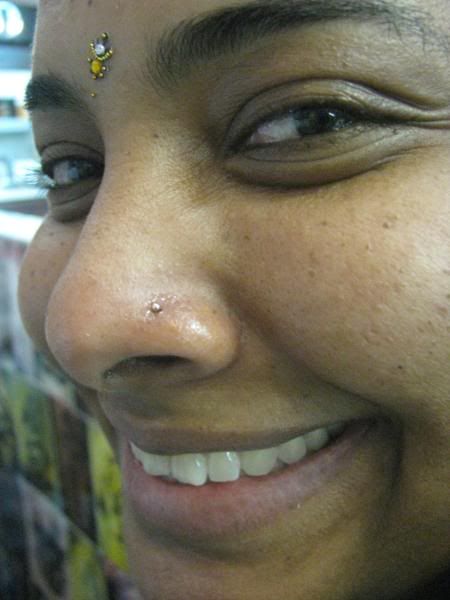
If the piercing turns too red and swollen you can make an ice compress. If the pain is unbearable, consult your doctor.
After your piercing is completely healed you cam fully enjoy it and wear the jewelry you like. Make sure you don't have allergy on the most common jewelry materials such as gold, silver steel and titanium.
Saturday, January 2, 2010


Subscribe to:
Posts (Atom)